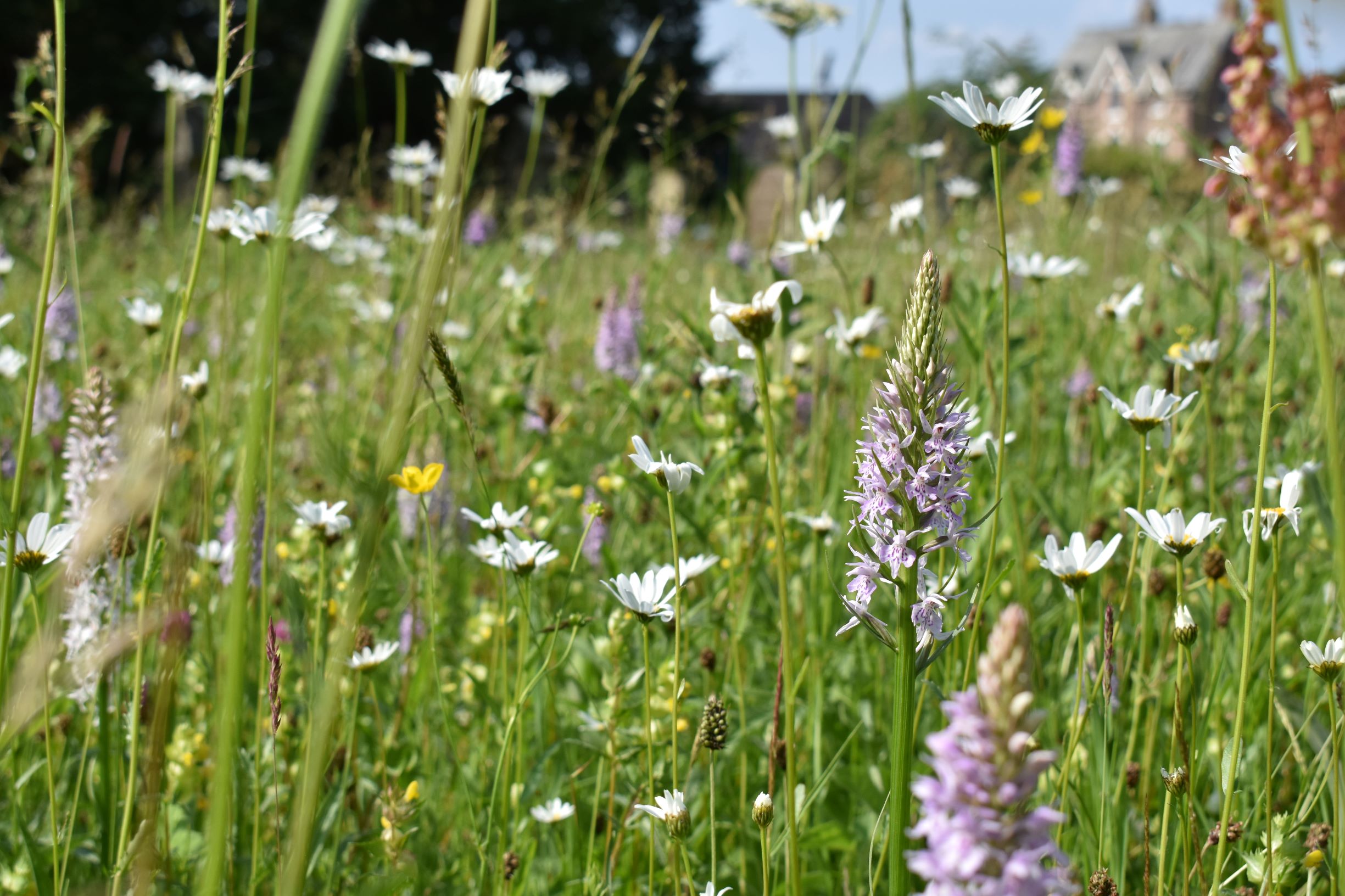
We are compiling this directory of flowery burial grounds from across the UK, which we would recommend visiting if you are looking for a well managed site rich in wildlife and heritage. Burial grounds can have a rich array of plants, animals and fungi, and may contain the only surviving area of flower-rich grassland in a parish. All the sites listed here contain this habitat. To see the flowers at their best, late May to mid or end of July is usually the most suitable time to visit. However, do contact the site managers for more specific timings before you visit if this is important to you.
St Michael’s, Lichfield
St Michael’s Churchyard is located on Greenhill in the Southern part of Lichfield. It is much older than the Church itself, and thought to date back to pre-Christian times. It covers a 9 acre area, making it one of the 5 largest churchyards in England. The natural features of St Michael’s Churchyard make it a very beautiful sacred space. There are over 500 trees, both deciduous and evergreen, with some rarities such as the Japanese Cork Tree and the Oregon Maple. Most of the common British tree species are present and there is an avenue of crab apple trees leading …
Church Street
Lichfield, Staffordshire WS13 6ED
- Birders paradise
- Famous/infamous people's memorials
- Fascinating monuments
- Good accessibility
- Great for fungi
- Lichen haven
- Peaceful space for quiet reflection
- Stones with stories
- Wild flower Areas in spring/summer
- Wildlife haven
St Nicholas’ - Carlton Scroop
This churchyard has been managed for its botanical diversity since 1996. The different habitats within the churchyard attract many different species of wildlife between 2015 and 2018 over 200 species of plants, invertebrates, mammals and birds have been recorded here. The site is a sensitively managed mix of long and short areas and contains gems such as betony, field scabious, lady’s bedstraw and St John’s Wort.
Carlton Scroop
Grantham, Lincolnshire NG32 3AX
- Peaceful space for quiet reflection
- Wild flower Areas in spring/summer
- Wildlife haven
St Paul's Church 'the Church in the Woods'
St Paul's is now a Key Ecological Site within the Forest of Dean. Recent work in the church has revealed the presence of several types of bat including the Soprano Pipistrelle and Lesser Horseshoe Bat. The outside walls and grounds are rich in rare and unusual lichens, fungi and insects; and we have large influxes of birders each spring to see our Hawfinches, Crossbills and Lesser Spotted Woodpecker. August 2021- first slow-worms seen in churchyard! August 2022 - first lizards seen in churchyard!! Since 2019 as part of our ecological conservation of the churchyards we are now mowing to a …
Parkend
Lydney, Gloucestershire GL15 4NA
- Birders paradise
- Good accessibility
- Great for fungi
- Lichen haven
- Wild flower Areas in spring/summer
- Wildlife haven
St Peter's Church, Goetre (Nantyderry)
A rural churchyard nestled between woodland and farmland. In parts the grass is left long until September which has encouraged a huge variety of wild flowers, fungi and wildlife. We are also blessed with some ancient yew trees and a lengthy hedgerow.
Nantyderry
Abergavenny, Gwent NP7 9DW
- Birders paradise
- Good accessibility
- Great for fungi
- Peaceful space for quiet reflection
- Wild flower Areas in spring/summer
- Wildlife haven
St Peter’s churchyard - Boughton Monchelsea
St Peter’s churchyard is looked after by a small group of volunteers with wildlife conservation in mind. The large churchyard, positioned on the south facing slope of the Greensand ridge. It is managed in different ways in different areas. Leaving areas of the churchyard to bloom into wildflowers has been the method of management at St Peters for at least the past 10 years. There are also areas which are more conventionally managed and regularly mown. The churchyard is a very special, in so far as it directly adjoins an ancient deer park. Biodiversity can range between the two relatively …
Church Hill
Maidstone, Kent ME17 4BU
- Birders paradise
- Lichen haven
- Lychgate
- Peaceful space for quiet reflection
- Wild flower Areas in spring/summer
- Wildlife haven
St Peter’s, Ayot St Peter
St Peter’s is a listed Victorian Church in the “arts and crafts” style that has been carefully maintained over the years and is in exceptional and original condition. The church features in the Simon Jenkins book “England’s Thousand Best Churches” (1999). It was designed by the noted architect John Pollard Seddon and completed in 1875. It has a fine font, pulpit and a beautiful painted ceiling in the chancel. It also features the only church commission undertaken by the famous Martin Brothers pottery. The parish war memorial stands in front of the church and commemorates twenty men who died for …
Ayot St Peter
Welwyn, Hertfordshire AL6 9BG
- Birders paradise
- Good accessibility
- Lichen haven
- Peaceful space for quiet reflection
- Stones with stories
- Wild flower Areas in spring/summer
- Wildlife haven
St Peter’s, Buckland-in-the-Moor
The churchyard at St Peter’s is a great example of unimproved, species rich grassland. The acidity of the soil limits the range of species present but the mixes of herbaceous plants and fine grasses are typical of the old grassland that can be found in churchyards. In the churchyard is an unusual thatched vestry, dating from the late 1700’s, it is believed to be the only surviving one in the country and is traditionally thatched with Devon Wheat straw. Originally an animal shelter, it has been used as a Dame school and a Sunday School before becoming the church vestry. …
Buckland in the Moor
Newton Abbot, Devon TQ13 7HN
- Good accessibility
- Great for fungi
- Lichen haven
- Peaceful space for quiet reflection
- Wild flower Areas in spring/summer
St Peter’s, Clifford’s Mesne
St Peter’s church is the focal point of Clifford’s Mesne, a small village near the market town of Newent in north-west Gloucestershire. The church was built in 1882 on an area of common land (some of the common survives, adjoining the churchyard to the north, and is used for the village fete and other events). The area enclosed for church and churchyard was only 0.4ha (1 acre) but the shallow, free-draining soil of this small burial ground supports an astonishing diversity of grassland and heathland plants – over 100 species at the last count. The few patches of deeper, more …
Clifford’s Mesne,
Newent, Gloucestershire GL18 1JL
- Birders paradise
- Famous/infamous people's memorials
- Good accessibility
- Great for fungi
- Lichen haven
- Peaceful space for quiet reflection
- Wild flower Areas in spring/summer
- Wildlife haven
St Peter’s, Westleton
The churchyard at St Peters dates back to the medieval era, when in 1340 the monks of Sibton Abbey built a church. The site may have been home to a wooden church before this and a 3000 year old burial urn has also been found here. Largely undisturbed, wildflowers have flourished in the churchyard. Between 1981 and 2009 the late Joan Westcott guided the management of the churchyard and recorded the many species of flora found at St Peters. Her work continues to this day by interested volunteers. The light soils mean that lady’s bedstraw and mouse-ear hawkweed thrive and …
The Street, Westleton,
Saxmundham, Suffolk IP17 3AG
- Fascinating monuments
- Good accessibility
- Peaceful space for quiet reflection
- Wild flower Areas in spring/summer
- Wildlife haven
St Peters Church C of E churchyard London Colney
The church built in 1825 faces the River Colne with adjoining Parish Centre, alongside these buildings is over an acre of churchyard in a conservation area. Formed in 1825 from hay meadows as London Colney was a stopping place to change coaching horses with inns for rest for passengers and coach drivers. London Colney also served as a resting place for drovers as cattle passed through for the London Markets. Quote from Herts Wildlife Survey "Churchyard comprises of neutral grassland and planted trees and shrubs along a walled boundary. The aspect is fairly neutral and the underlying geology has a …
Riverside, London Colney
St. Albans, Hertfordshire AL2 1QA
- Good accessibility
- Peaceful space for quiet reflection
- Wild flower Areas in spring/summer
- Wildlife haven
St Stephen’s, Llanstephan
Located near the crest of the hill, with extensive views SE over the Wye Valley, this beautiful churchyard is quite a treasure. The ovoid churchyard is 0.5 hectares, well managed and has two notable and four veteran yews. The grassland is quite species rich and, along with the more common ox-eye daisies, buttercups and yarrow, it has some less common species such as pignut, crosswort and betony. The church appears to date from the 13th or 14th century, with a two-and-half stage tower.
Llanstephan
Nr Glasbury, Powys LD3 0YR
- Birders paradise
- Good accessibility
- Great for fungi
- Lichen haven
- Lychgate
- Peaceful space for quiet reflection
- Wild flower Areas in spring/summer
- Wildlife haven
St Tudno’s, Llandudno
About this churchyard The churchyard is managed to allow wildflowers and wildlife to thrive, while preventing the graves from becoming overgrown. Despite this being a difficult balance to reach the churchyard appears to be flourishing with 70 species of higher plants being recorded in 2014. The grass is cut twice a year and as much of the cut grass as possible is raked and removed, to encourage the growth of other plants. Surveys of lichens have been performed by the British Lichen Society in 1992 and in 2015 as part of a nationwide churchyard survey. These surveys have shown more than 100 …
Saint Tudno’s Road
Llandudno, Conwy LL30 2XE
- Great for fungi
- Lychgate
- Peaceful space for quiet reflection
- Stones with stories
- Wild flower Areas in spring/summer
St Tysilio Church, Llantysilio
St Tysilio church is located near Llangollen and sits right next to the River Dee. The churchyard is surrounded on the southern, northern and western boundaries with mature broadleaf trees, including Lime, Sycamore, Horse Chestnut and Oak and there are a number of mature Yew trees. The grassland within the burial ground has beautiful wildflowers in the summer, some of these flowers include Germander speedwell, Primrose, Enchanters nightshade, Cuckooflower, Lesser celandine, Red campion, and Rosebay willowherb.
Llantysilio
Llangollen, Conwy LL20 8BT
- Birders paradise
- Famous/infamous people's memorials
- Fascinating monuments
- Good accessibility
- Lychgate
- Peaceful space for quiet reflection
- Stones with stories
- Wild flower Areas in spring/summer
- Wildlife haven
St. John The Evangelist, Clitheroe
There are two churchyards – the older one surrounding the church, and the newer one across the road. Both churchyards are managed for the benefit of wildlife, with a limited mowing regime to encourage biodiverse flora and fauna. A bioblitz in 2018 reported over 350 species! There is a wildflower meadow in the new churchyard, which is scythed by volunteers with the Bowland Haytime Project, in late summer. There are magnificent views across the Ribble valley. Download a spreadsheet (Excel) of species found during our Bioblitz
Shire Lane, Hurst Green,
Clitheroe,, Lancashire BB7 9QR
- Fascinating monuments
- Lichen haven
- Lychgate
- Peaceful space for quiet reflection
- Wild flower Areas in spring/summer
- Wildlife haven
St. Mary's Church, Hanley Castle
The churchyard surrounding St. Mary’s is crossed by public footpaths, one of which is part of the Wyche Way, a long distance path from Kington to Broadway. There are areas of mown grass, areas of spring flowers, wildflower areas and areas devoted to wildlife. Hedges surround most of the site and there are numerous trees including old yews and limes planted for the victory at the Battle of Blenheim in 1704. The churchyard is part of the Hanley Castle Conservation Area which affords a level of protection supplemented by Tree Preservation Orders on most of the trees.
Hanley Castle
Worcester, Worcestershire WR80BL
- Famous/infamous people's memorials
- Peaceful space for quiet reflection
- Sundial
- War memorial
- Wild flower Areas in spring/summer
- Wildlife haven
The Long Barrow at All Cannings
The Long Barrow was built in 2014 in the style of a Neolithic Long Barrow updated to be useable in the 21st Century. It houses cremated remains in natural stone niches within chambers inside the barrow. The exterior has been restored to species rich chalk grassland. The interior has controlled access for the security and dignity of the remains but the exterior is free to visit at all reasonable times. The spring and early summer is best for flowers as the grasses are allowed to grow to flowering and seed. There is an interpretation board on site.
Woodway Bridge
All Cannings, Wiltshire SN10 3NX
- Lichen haven
- Peaceful space for quiet reflection
- Wild flower Areas in spring/summer
- Wildlife haven
Tower Hamlets Cemetery Park, London
The Cemetery Park is a Local Nature Reserve (LNR) and conservation area in the heart of East London, managed by the Friends of Tower Hamlets Cemetery Park on behalf of the Council. The cemetery forms part of the Site of Metropolitan Importance for Nature Conservation and is one of London’s Magnificent Seven Victorian cemeteries. Most of the Cemetery Park is woodland which has been greatly diversified over time, with a gradual reduction of sycamore, new tree planting, and the development of a rich groundcover of grasses, bulbs and wildflowers. About a third of the Cemetery Park is grassland, much of …
Southern Grove,
Tower Hamlets, London E3 4PX
- Birders paradise
- Famous/infamous people's memorials
- Fascinating monuments
- Good accessibility
- Great for fungi
- Lichen haven
- Peaceful space for quiet reflection
- Stones with stories
- Wild flower Areas in spring/summer
- Wildlife haven
United Reformed Church, Libanus
This burial ground has been kept well mown and tidy for many years. Three years ago, the membership took the decision to let two areas stay uncut from spring to autumn. To our surprise the ‘meadow’ area is beautiful. We have wild Orchids – three types, Harebells and many other beautiful flowers and grasses. The Brecon Beacons National Park have recognised the beauty of the area and designated it a Site of Interest for Nature and Conservation status. It is all very new to us and we are learning as we go along, there is no seating and we wonder …
Libanus
Brecon, Powys LD3 8EW
- Lichen haven
- Wild flower Areas in spring/summer
- Wildlife haven
Warstone Lane Cemetery
Located in the heart of Birmingham's Jewellery Quarter, Warstone Lane Cemetery, also known as the Church of England Cemetery, opened in 1848. The cemetery was created on the site of a former sand quarry, creating a dramatic landscape used to maximum effect when creating the famous circular catacombs. The cemetery chapel, dedicated to St Michael and All Angels was demolished post WWII, following bomb damage to the roof. The chapel footprint is now marked by a Garden of Memory, which contains a small orchard and benches for quiet contemplation. Originally laid out as a garden cemetery, the site is now …
Jewellery Quarter
Birmingham, West Midlands B18 6LP
- Birders paradise
- Famous/infamous people's memorials
- Fascinating monuments
- Good accessibility
- Great for fungi
- Interpretation boards
- Peaceful space for quiet reflection
- Stones with stories
- War memorial
- Wild flower Areas in spring/summer
- Wildlife haven
Yealand Quakers Yealand Conters
Small secluded low key burial ground. One area managed as a herb rich meadow. semi ancient Yew/ Holly trees Fantastic views over to Inglenborough in the Yorkshire Dales, Hutton Roof and Drumlins from Lake District Glaciers. The historic meeting house 1680's is open through the day for quiet contemplation/ prayer and has a self serving hospitality tray.
Yealand Conyers
Carnforth, Lancashire LA5 9SH
- Famous/infamous people's memorials
- Good accessibility
- Peaceful space for quiet reflection
- Stones with stories
- Wild flower Areas in spring/summer
- Wildlife haven
The map below will take a few seconds to load. You can search for a burial ground either by county, or by the name of the burial ground, or by clicking the markers on the map.