For the second Love your Yew Week in collaboration with the Ancient Yew Group we are asking custodians of ancient and veteran yews to look down at the ground beneath your yew tree.
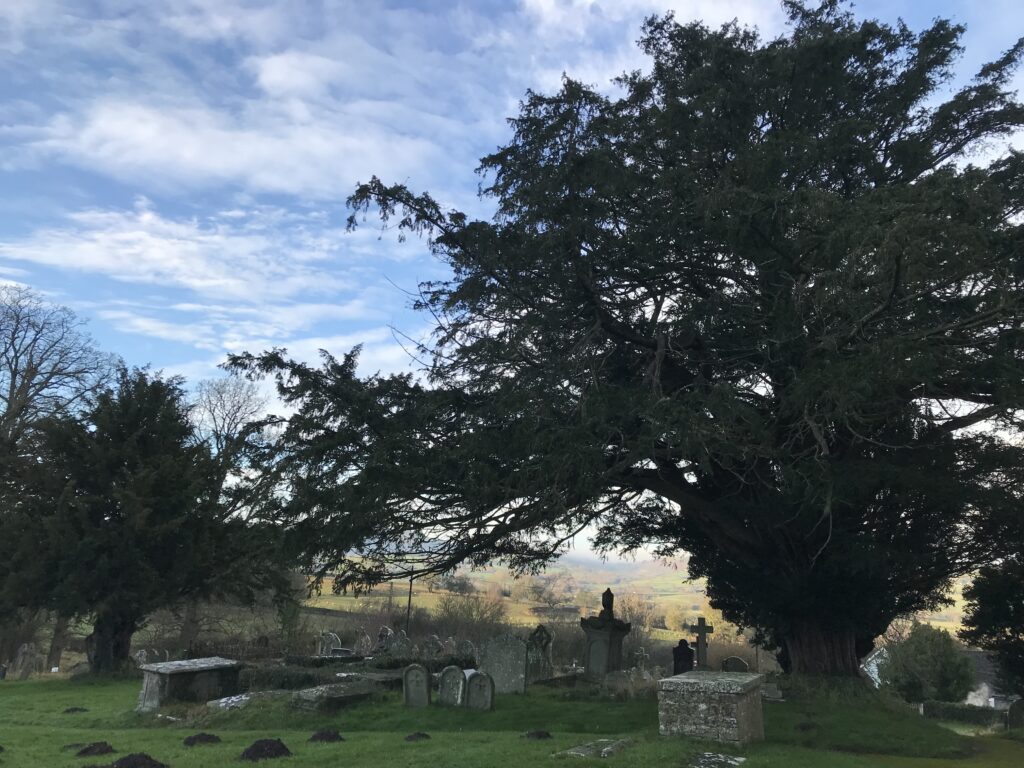
The theme for 2026 is to clear beneath the canopy, removing all objects, including at least a metre beyond the canopy, as the roots can extend further than the branches. See the FAQ below to learn about what – and what not – to remove.
There are about 800 of these wonderful trees in the churchyards of England and Wales, which is a large proportion of the British population. Internationally, Britain is a stronghold of veteran yew trees and so these churchyard yews are really important on a global level. They are a national treasure which deserves recognition and celebration.
In Love your Yew Week we suggest a specific management task to complete, with the aim of breaking down the job of caring for them into achievable tasks. February is a good time of year to carry out any work on yew trees, before birds are nesting and hopefully a time of year that is not too busy with other tasks. Those who take part are sent a certificate which celebrates these remarkable trees and which can be displayed to let the public know there is a special tree present.
Please join in and please send us before and after photographs! We would love it if your photos include people, but do please make sure you have their permission, as they will go into our website.
Younger yews benefit from care too so please join in even if your yew trees are not veteran.
FAQs
What’s so special about ancient yews in churchyards?
There are about 800 ancient and veteran yews in the churchyards of England and Wales, this is a large proportion of the British population. Internationally, Britain is a stronghold of veteran yew trees and so these churchyard yews are really important on a global level. They are a national treasure which deserves recognition and celebration.
Why have a special week?
Churchyard yews are the responsibility of Parochial Church Councils (PCC), groups of volunteers who care for our churches and churchyards. We are keen to support and encourage these volunteer ‘Yew Guardians’. By having a special week, with a specific management task to complete, the job of caring for them is broken down into achievable tasks. Those who take part are sent a certificate which celebrates these remarkable trees and which can be displayed to let the public know there is a special tree present.
When is it?
Love Your Yew Week takes place each February, which is a good time of year to carry out any work on yew trees, before birds are nesting and hopefully a time of year that is not too busy with other tasks. In 2026 Love Your Yew Week will run from the 9th to 15th February.
What is it?
Love Your Yew Week started in 2025, it is an initiative dedicated to the care of ancient yew trees. This annual week encourages those caring for these special trees, most of which are within churchyards, to focus on simple yet impactful ways to safeguard these trees.
Who organises Love Your Yew Week?
Love Your Yew Week is run by Caring for God’s Acre, the conservation charity for burial grounds, and the Ancient Yew Group, a conservation body which collects field data and historic material about our oldest trees. Many members of the Ancient Yew Group are tree professionals who have specialised in ancient trees so their knowledge is vital to the initiative.
What do ancient yews need?
Ancient yews, indeed all yews, are resilient and need little management. Sometimes they may seem to be dying back, with deadwood visible, and will then recover, putting out new growth from epicormic buds. Leaving them alone is often the best thing to do. There are a few things that cause problems however:
1 Smothering and compaction of the root plate.
2 Ivy growth on the trunk and into the canopy.
3 Sudden changes and reductions in the amount of sunlight, oxygen or water reaching the tree.
Apart from this yew trees are often best left alone. Pruning, particularly of an old tree, not only causes a wound but also alters the ratio of needles to wood. Yew trees have a small canopy with a lot of wood to feed! Removing boughs full of needles can reduce this even further.
The theme for 2026 is to clear beneath the canopy
Remove all objects from beneath the yew canopy, including at least a metre beyond it, as the root plate can extend further than the branches. Pull up any small seedling trees or woody shrubs and cut saplings back close to the ground.
What is the Root Plate?
Tree roots are found within the first 60cm of soil where there is ample oxygen which the roots need. The roots of most trees grow as a shallow disc, known as the root plate. Changes to the root plate such as piling material onto it or putting heavy things there may damage the roots.
What are Epicormic Buds?
Epicormic buds are found beneath the bark of the tree trunk and boughs. They lie dormant, suppressed by hormones, until a tree experiences damage within the tree or a sudden increase in sunlight reaching the trunk, usually when surrounding trees are removed. Under these conditions the epicormic buds start to grow into shoots. Epicormic growth is a key way that trees respond to change and stress and for yews in particular, increases the numbers of needles photosynthesising and producing energy for the tree.
What’s wrong with putting things under yew trees?
It’s tempting to put objects out of sight beneath a yew canopy. Typical examples range from grave spoil to piles of stone, grass cuttings, sheds and mowers. On occasion, cars are parked beneath a yew canopy or even fuel tanks.
Trees depend on their root plate for oxygen and water. Smothering of the root plate with, for example, piles of grave spoil or grass cuttings affects the oxygen and water reaching the roots. Placing heavy items will compact the soil. This may crush the roots themselves as well as reducing the movement of oxygen and water through the soil. Fuel tanks, cars and mowers not only compact the soil but also run the risk of leaking fuel, releasing toxins into the soil and to the roots, potentially killing them.
Is there anything I shouldn’t remove from under yew trees?
At certain times of the year, mushrooms can be observed beneath yew trees, but these may not represent problems to the tree or its environs, as these are just the body through which the fungus reproduces itself. Mushrooms are the fruit of an underground hidden organism; their purpose is not to feed the tree directly, but to cast their microscopic spores into the air. The yew is not being harmed; it is being helped, its domain kept tidy, its soil enriched, its roots sometimes fed.
A few mushrooms are considered quite rare and endangered and are listed as such on both the UK and European Red Lists. If unsure of the species you find and have concerns, please consult your local Flora/Fungi group, as true stewardship often begins not with knowing the answer, but with knowing who to ask.Some wildflowers such as bluebells or lesser celandine, as well as native grasses may grow beneath trees and can be left. It is shrubs and tree saplings that can cause problems.
You may find ivy growing along the ground under your yew tree. Ivy is not really a problem on the ground, but keeping a check on it may be the best solution in order to avoid allowing it to grow back up the yew tree. If you do want to remove any, pull it up rather than digging it up to avoid tree root disturbance. Ivy may take up soil nutrients locally, but it also shades the ground, which can reduce ground temperature and help retain soil moisture.
What about trees growing under yew trees?
No one likes to cut down young trees but our ancient yews are so special that this can be justified. Removing nearby young trees that will, in time, over-top a yew is helpful. Trees often grow from seed under yew trees and will in the future push through the canopy blocking the sunlight and competing for water. Elder and holly in particular are often found growing beneath yews, perhaps from berries dropped by birds roosting in the yew canopy.
If self-sown seedlings are growing beneath or near to a yew tree then pull them up or carefully dig them up, disturbing the soil as little as possible. Often these seedlings can be transplanted, either within the churchyard, perhaps to thicken up a hedge, or potted on to be planted elsewhere. Sometimes you may find yew seedlings growing beneath the parent tree in which case do try and keep them, pot them and then find a place where they can grow to become veteran yews of the future.
Smaller saplings including rowan, holly, hawthorn and elder can sometimes be dug up without disturbing the yew roots in which case perhaps they can be replanted elsewhere or donated to a community tree nursery.
Larger saplings should be cut to the base, which probably will need to be repeated regularly. Pulling them up is not only difficult and bad for backs but would actually disturb the soil and the root plate so cutting is best.
I haven’t heard of Love Your Yew Week before, what have I missed?
This is the second year that we have run it so you can easily catch up! Last year people were encouraged to remove ivy from yews. If you are new to this, you might choose either task or, if particularly keen why not do both?
It sounds great, how can I be involved?
The idea of Love Your Yew Week is to focus on one task per year, helping those who care for these fabulous trees to manage the work needed.
I’m keen to take part but have no involvement with my local church or churchyard
You will need to make contact with the vicar or churchwarden of the churchyard which contains the yew. There may be contact information on the church notice board or in the porch, you can also try the website A Church Near You. Churchwardens and other churchyard volunteers will usually value help when offered and so asking permission to take part in this initiative is likely to be welcomed. Thought may be needed when clearing below the canopy, a new place to pile for grave spoil or grass cuttings may be needed for example, so giving people time to make alternative plans is the best way to succeed.
In Love your Yew Week last year I cut back the ivy from our yew, do I need to do this again?
Yes, whilst the ivy will have been greatly reduced, it will have spent the summer regrowing from the roots. Please take some time to remove any regrowth whilst it is still young and easy to pull off the tree. Hopefully this is now a quick, annual task rather than the bigger undertaking of the previous year. Over time the ivy roots will be weakened and reduce, lessening the amount of regrowth but removing ivy will always be a long-term maintenance task.
How do I remove ivy safely from yews?
Managing ivy on ancient yews requires care. Follow these steps to prevent harm to the tree or the person removing ivy:
1. Sever Ivy at the Base
Cut Ivy Trunks Carefully: Sever ivy stems around the yew’s trunk base, removing at least a 3-4 cm section to prevent the ivy re-grafting and continuing to grow.
When to Cut: Although the ivy will continue to provide roosting and nesting spots for many months after cutting, avoid the bird nesting season to reduce the chance of disturbance. Cut after August and before March. Within 12 months the ivy will begin to shed its leaves with only their bare stems remaining – continuing to provide valuable habitat until they decay over time.
Use Proper Tools: Opt for folding handsaws and secateurs, avoiding chainsaws that risk damaging the yew’s bark or the cambium beneath the bark. For thick ivy, or ivy growing in trunk folds, use a handsaw where you can and then lever the ivy off with a wedge or woodblock. If this doesn’t work then you can try a chisel with a rubber mallet but do be careful not to allow the chisel to damage the yew.
Safety Precautions
Always wear protective gloves and glasses during ivy removal to avoid injury.
3. Supplement Nesting Habitat
As ivy removal may reduce nesting sites, why not install bird and bat boxes nearby as well as leaving ivy to flourish in other areas where it is not damaging.
4. Annual Maintenance
Repeat Ivy Removal: As ivy roots intertwine with those of the yew, regrowth is inevitable. Regularly inspect and remove young ivy stems annually to prevent reestablishment. If done annually this is a relatively quick and easy task.
Isn’t ivy good for wildlife?
Yes, ivy is great for wildlife in the following ways:
- It provides an important nectar source in the autumn when ivy flowers are out. Bees, butterflies, and hoverflies all benefit as do other insects.
- The berries are a source of winter food, full of energy. These help sustain birds and mammals through winter.
- The Holly Blue, known as the churchyard butterfly, relies on ivy as well as holly. Holly Blues have two broods per year, the first hatch in spring on holly and the second in late summer or autumn on ivy.
- Ivy branches and the evergreen leaves offer shelter for invertebrates, small mammals and birds. Dense ivy gives protection from predators all year round, providing overwintering and nesting places for many creatures. Concentrations of invertebrates within ivy offer, in turn, a food source for larger animals and birds such as wrens which can be seen hopping through the ivy gleaning for food.
BUT ivy is a common plant found in many places including on other types of tree from which it does not need removing. Our ancient yews are a very special case and ivy growth can be extremely damaging to them. Removal of ivy from ancient yews is recommended by tree experts.
What's the difference between Irish yews and common yews?
The Irish Yew (Taxus baccata ‘Fastigiata’) is more upright, neat in shape and not nearly as long lived as the common yew (Taxus baccata). It was originally discovered in County Fermanagh in 1780, and it is thought to be a mutant form of the common yew. All Irish yews come originally from cuttings taken from this tree as any seeds grown will not be the mutant form and will revert back to the common form.
The needles are darker than those of the common yew, and unlike the latter the needles grow all around the twig, rather than in rows.
The management tasks listed for yews are also suitable for Irish yews
Where can I find out more?
A good place to start is to watch a couple of minifilms:
Chris Baines, a CfGA patron, gives a brief introduction to Ancient Yews
Russell Ball of the Ancient Yew Group gives a wealth of useful information on Ancient Yews
To find more information:
Take a look at the Caring for God’s Acre website where we have resources on veteran trees.
Visit the website of The Ancient Yew Group for lots of information and expert advice including a gazetteer of ancient, veteran and notable yew trees.
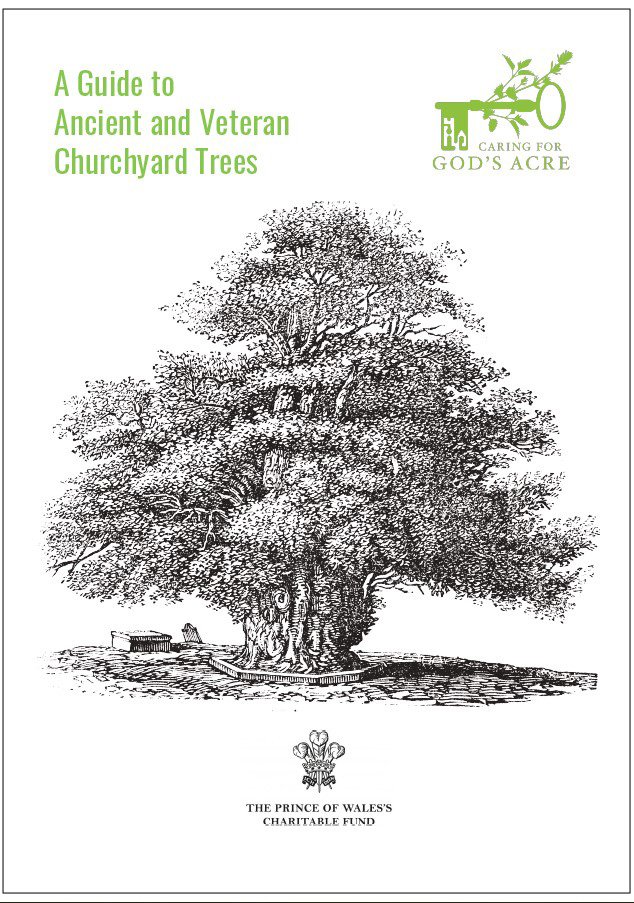
Ancient Yew Trees with Chris Baines
Chris Baines, one of our patrons, explains the relationship between yew trees and holy places. Some yew trees are thought to be 3,000 or 4,000 years old, pre-dating the Christian land on which they stand
Managing Veteran Trees with Russell Ball
This video covers best-practice management of these precious trees with a few mis-management myths thrown in. Russell Ball is a Chartered biologist with a Botany degree and post-graduate diploma in Landscape Management.