This project is made possible by the generous support of our funders.
Using money raised by National Lottery players, The National Lottery Heritage Fund supports projects that connect people and communities with the UK’s heritage. Our Digital Ancestors is made possible with The National Lottery Heritage Fund. Thanks to National Lottery players, we will be able to connect volunteers around England to the digital mapping project and discover the stories of people buried in Church of England churchyards.
The National Lottery Heritage Fund is the largest funder for the UK’s heritage. Using money raised by National Lottery players we support projects that connect people and communities to heritage. Our vision is for heritage to be valued, cared for and sustained for everyone, now and in the future. From historic buildings, our industrial legacy and the natural environment, to collections, traditions, stories and more. Heritage can be anything from the past that people value and want to pass on to future generations. We believe in the power of heritage to ignite the imagination, offer joy and inspiration, and to build pride in place and connection to the past.

This project is funded by Historic England, the public body that helps people care for, enjoy and celebrate England’s spectacular historic environment, from beaches and battlefields to parks and pie shops. Historic England protect, champion and save the places that define who we are and where we’ve come from as a nation. Historic England care passionately about the stories they tell, the ideas they represent and the people who live, work and play among them. Working with communities and specialists they share passion, knowledge and skills to inspire interest, care and conservation, so everyone can keep enjoying and looking after the history that surrounds us all.
Historic England’s mission is to:
Champion, helping people discover the hidden gems and great places that add colour and character to our lives.
Include everyone’s history because we know every community makes a contribution that’s worth understanding and celebrating.
Protect by identifying the most important parts of our heritage, by listing and conserving, and by speaking up for places that are at risk.
Care by empowering communities and professionals to look after their local heritage.
The Church of England is the established church in England which is divided into 42 dioceses and 12,500 parishes across the country. The financial and in-kind contributions of the Church of England to the Our Digital Ancestors project will give parishes, congregations and volunteers access to churchyards and training to learn the stories of the people buried there.
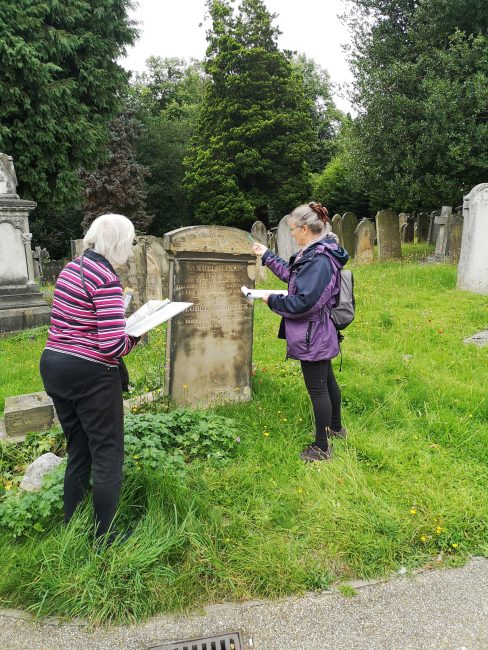
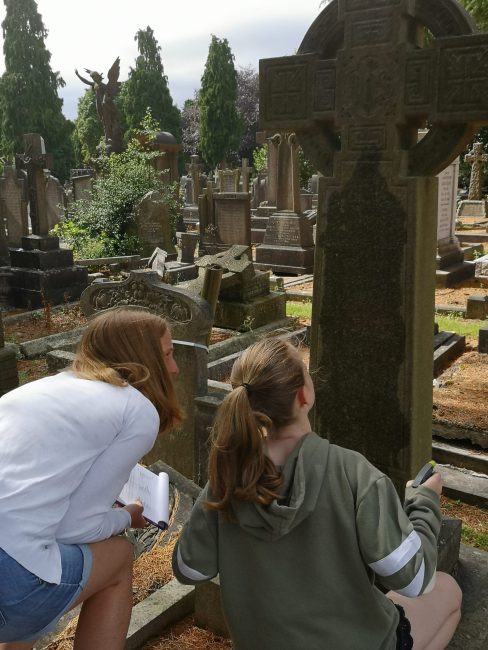
Other Partners

Atlantic Geomatics’ dream is to be admired as the best little big Geospatial company in the world. They strive to assist both public and private organisations to harness the power of spatial data.
Caring for God’s Acre have used their Burial Ground Management System at Longden Road Cemetery, Shrewsbury and on 5 sites in Birmingham during the Celebrating Birmingham’s Beautiful Burial Grounds Project and have continued to work with these sites and their volunteers as part of Our Digital Ancestors. We have also developed a training course on how to use the Burial Ground Management System aimed at helping clients and especially volunteer groups to make the best use of the software’s capabilities.
We believe that the on the ground survey techniques developed by AG Intl are the best way to get accurate maps of large sites and those with lots of tree cover, both of which are difficult to survey using drones. They also offer photography, record scanning and transcription services to clients, which can vastly speed up implementation of the system and have a big impact on record keeping and burial ground management as well as providing a record of the memorials. The BGMS will cut down on time spent on enquiries and can even help manage the burial ground for nature:
Colin Fenn, Malvern Wells Parish Cemetery: “Malvern Wells is a small burial ground of a little more than 1000 graves, but because of some issues around record keeping in recent years, we used AG here to map the parish burial ground and transcribe the burial register to place it online. The mapping went through fairly quickly and looks to be very accurate. The transcription is not perfect but it is very good considering the quality of handwriting it came from. We have asked the local family history society to validate it using their local knowledge. There were also gaps in the historical cemetery burial map, so with cross-referencing we hope to reclaim a number of spaces that were never used or which were exhumed after WWII. The digital maps will also be used to help establish a conservation management plan and inform us of areas where we can contemplate meadow planting without disturbing recent graves, and complement our current trees.
Interested? Get a quote from AG Intl.