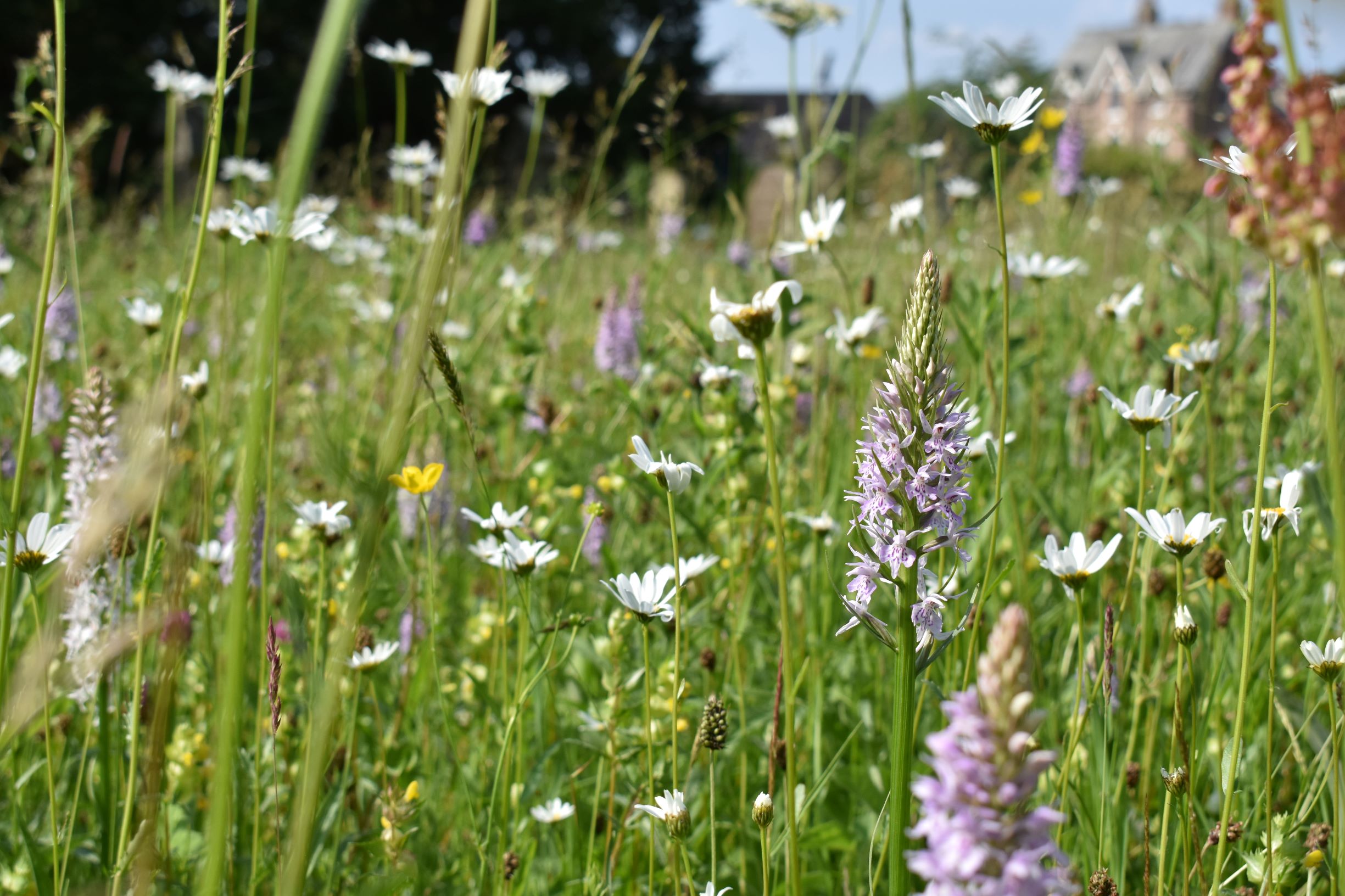
We are compiling this directory of flowery burial grounds from across the UK, which we would recommend visiting if you are looking for a well managed site rich in wildlife and heritage. Burial grounds can have a rich array of plants, animals and fungi, and may contain the only surviving area of flower-rich grassland in a parish. All the sites listed here contain this habitat. To see the flowers at their best, late May to mid or end of July is usually the most suitable time to visit. However, do contact the site managers for more specific timings before you visit if this is important to you.
St Mary’s Church Chiddingfold has a wonderful and historic churchyard, covering about four and a quarter acres. William de Wanda, Dean of Salisbury, recorded in 1220 that there was already at Chiddingfold a cymeterium, so the churchyard has been used as a burial site for many centuries. The Cemetery Listing contains nearly 4,500 names of people buried here. The churchyard also provides a well-used walking route, both for recreational purposes and for access to the Church and Village Green area for residents in the upper part of the Village. Entrance is through a fine Lych Gate.
The predominant habitat type in Chiddingfold churchyard is wildflower grassland, and glorious carpets of early crocuses, and a succession of native primroses, wood anemone and stitchwort appear in spring. The churchyard also has hedges of variable styles and numerous fine trees. One of the major Oak Trees is subject to Tree Preservation Order. Others have been planted for commemorative purposes.
The churchyard habitats provide an important food source, including berries and seeds, for birds, insects and other invertebrates, small mammals, rodents, and bats. Observations confirm the presence of a variety of butterflies and moths, bees, hoverflies, grasshoppers and crickets, beetles including ladybirds, spiders, crustacea and molluscs. These all form a vital food resource for the birds, mammals and reptiles inhabiting the churchyard.
The churchyard has been designated as an official site of the rare and endangered Wood White Butterfly.
The churchyard has several interesting and unusual features
- The Church Room is an elegant modern structure sunk under a curved grassed roof and was the winner of the RIBA Ibstock Downland Prize for 2011 – Religious Category.
- There are 24 rare brick barrel graves and three individually Grade 2 listed tombs, all dating from the 19th Century.
- Several Commonwealth War Graves can be found with their distinctive headstones.
- Very unexpectedly in an English churchyard, several headstones in Cyrillic script commemorate the residents of Sydenhurst Residential Home, originally the “Ukrainian Invalids Home” in the Village, founded in 1949 to provide a safe haven for Ukrainian veterans and invalids unable to work who had made England their home after the Second World War.
- At the west end of the new churchyard lie the graves of two Gypsy families.
- The Village War Memorial Cross lies within the churchyard.
A comprehensive Churchyard Management Plan was adopted by the Parochial Church Council in 2020. Its purpose is to integrate management of the churchyard in a way that best supports all its functions. An important aspect is balancing the call for a tidy and ‘cared-for’ appearance with the need to sustain and celebrate wildlife resources (considered by some to indicate ‘untidiness’). This challenge has been addressed by way of ‘zoning’ the management regime to reflect the prominence and ecological value of various areas of the churchyard.
The churchyard is cared for by the volunteer monthly Churchyard Working Party, which carries out general maintenance, cares for the Gardens of Remembrance and ensures that the churchyard is presentable, particularly for major events and services.
More major maintenance falls under the Churchwardens’ responsibility and is carried out by volunteers on an ad hoc basis or by the employment of suitable contractors. The mowing regime is carried out by a paid contractor and consists of:
- Close mowing of the areas around the Church and Church room on a frequent basis for appearance purposes, as well as access paths in the remainder of the churchyard.
- Strimming the rest of the churchyard in a number of rotational zones:
- Middle Churchyard – Zones 1, 2 and 3 – Areas of high conservation value with wildflowers that are favoured as foodplants present, which will permit egg-laying and pupation to occur if it is allowed to mature. Zones are strimmed on a three-year rotational basis.
- Old Ground Zone 4 – Grassed area of relatively low conservation value is strimmed twice a year.
- New Churchyard – Annual strimming until wildflowers are well established, whereafter this part of the churchyard will be divided into Zones 1, 2 and 3 for rotational strimming.
- Zone 5 – mostly heavily shaded and of low ecological value – strimmed when required for appearance.
- Zone 6 – All access paths as well as a grassed bank are close mown on a regular basis to ensure a tidy appearance and provide access.
- Birders paradise
- Famous/infamous people's memorials
- Fascinating monuments
- Good accessibility
- Great for fungi
- Lichen haven
- Lychgate
- Peaceful space for quiet reflection
- Stones with stories
- Wild flower Areas in spring/summer
- Wildlife haven
There are two large signs – Guide to the Churchyard – one at the Lych Gate, the other at the far end of the churchyard.
The burial ground is largely level. There is a surfaced path that slopes gently uphill from the lychgate which them levels out. This path is paved, but is uneven in some areas. Other paths in the burial ground are grass and are regularly mowed. There are five wooden benches and one stone bench scattered around the churchyard.
Bus No 71 (Guildford to Woolmer Hill) stops almost opposite the church. It runs once per hour.
The map below will take a few seconds to load. You can search for a burial ground either by county, or by the name of the burial ground, or by clicking the markers on the map.