If you are interested in counting wildlife in your local churchyard or cemetery – visit this page to learn how to get started and share your records .
Love your Burial Ground Week is a celebratory week which has been running for many years. Caring for God’s Acre has been encouraging all who help to look after churchyards, chapel yards and cemeteries to celebrate these fantastic places in the lovely month of June – in any way you choose. We’ve seen history talks, picnics, volunteering work parties and even abseiling teddy bears!Â
Churches Count on Nature 2026 runs at the same time as Love Your Burial Ground Week, and focuses on the brilliant wildlife to be found in churchyards and chapel yards. It is a joint initiative promoted by Caring for God’s Acre, the Church of England, the Church in Wales and A Rocha UK. National Cemeteries Week is hosted by the National Federation of Cemetery Friends.Â


Yes certainly!
If you would like to record wildlife during the week simply head to a churchyard, cemetery or other type of burial ground and make a note of what you see – from the trees and flowers to the birds and bugs. You can find information on this webpage about how to send in your records, including using iNaturalist.
If you want to organise an event or activity
Love Your Burial Ground Week is open to any group wanting to run an activity in any type of burial ground – whether it is a cemetery, chapel yard, natural burial ground or churchyard. Obviously you will need permission from the managing/responsible group for the site!
Most activities are organised by those responsible for the burial ground – often in partnership with other local groups such the Local History Society, local school or local wildlife group. For a list of handy resources to help you organise your event, please visit this page.
If you are organising an event, once you know what you want to do, simply fill in our registration form and your event will appear on our list.
The nature of your own activity/event is up to you, and will depend on:
So for example you might:
We strongly recommend using the fun and easy to use iNaturalist App to record wildlife and submit your records – more information here.
If you are using pen and paper method we need to know:
If you are sending a written list please give us the English name, and if you know the Latin name too, then include it. Don’t worry if you don’t, English is fine. NB. If you use the iNaturalist system it adds the Latin name automatically!
Once you have a final list then please, please, please send your records to Caring for God’s Acre. You can upload them via iNaturalist, email a written list to wildlife@cfga.org.uk or pop the list in the post. N.B. if you use the iNaturalist app this will help you to identify species as well as sending in your records so it is really helpful.
Recording species and sharing those records is a first step towards being able to protect them.
More info can be found on the video ‘Why Record’ at https://www.caringforgodsacre.org.uk/resources/films/video-why-record-wildlife/
The collated information allows national agencies to know what precious species are located where in the country. It helps the Church of England and the Church in Wales to know whether they are fulfilling their aims to care for and increase biodiversity and can be really useful if site managers are making an application for a grant.
The information also flows through to the church’s record on the online Church Heritage Record and Church Heritage Cymru.
Â
It is worth checking with your insurer that the site/event is covered by your existing insurance and that it is up-to-date. However, it is no different from holding outdoor worship, summer fete, or any other outdoor group activity in the burial ground.
You will need to carry out a simple risk assessment for your own site and the activity you are running. Please have a look at our resources page for information to help you prepare your own risk assessment. The most common risk is people tripping over tree roots or graves and kerbs.
If you are running it jointly with another group, then check who will be responsible for any accident/injury on site with regards to insurance.
It is totally free to register your activity and feature on our map. Â
Then what you spend is totally in your own control. Â
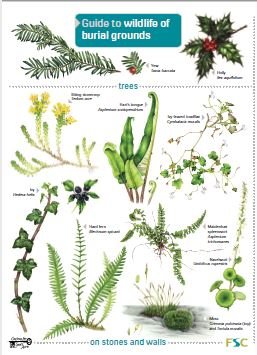
Email Caring for God’s Acre at enquiries@cfga.org.uk and ask for your free hard copy of their Starter Guide to get going – also available in English and Welsh downloads . You can view it on the website here. In addition, we will send you a copy of our FSC chart, Wildlife in Burial Grounds. For 2026, the first 500 burial grounds to register will receive a copy of I am a Swift, I am in Trouble.
This depends. You will need to decide a few things locally which will affect what needs doing:
Having decided this, you will need to think through:
The key thing is that everyone feels able to join in, so try to find a way for all to contribute. Perhaps people will be able to bring items such as tree leaves to a central table for help with identification? Spread out some identification books or the Field Studies Council charts to help.Â
You might give out clipboards and paper and ask people to make their own lists, or have a blackboard, flip chart or post-it notes for them to add their findings to the growing list of things. See our Resources page for templates you can use. For example, give a few tips to those new to this, including children.Â
‘Can you see a molehill? Who made that?’
‘Do you know what a robin looks like? What about a holly tree?’
By the end of the event, someone needs to have drawn up a list of all of the species seen and communicate this to all who took part. Keeping a running tally during the session is fun, and remember to publicise your findings. This might be a notice on your notice board, a round-robin email, an article in a parish magazine or all of these.Â
Please, please, please send your records to Caring for God’s Acre. You can upload them via iNaturalist, email a written list to wildlife@cfga.org.uk or pop the list in the post.Â
Â
Not everyone involved needs to know about identifying species, but it is more interesting if some people are well informed and can help others. You might want to involve some experts from a local wildlife group to help on the day, and there are lots of helpful FREE resources on our website here.Â
Other information on how to identify species can be found in various ways:Â
Useful resources for your event can be found here.
You can find a host of videos on running similar events (for Love your Burial Ground) on the Caring for God’s Acre website at: www.caringforgodsacre.org.uk/resources/films/Â
Â
After you have submitted to your records to iRecord or iNaturalist, they require verification by experts before they move forwards to the Burial Grounds Portal. Unfortunately, some areas and species groups do not have active verifiers. For example, the verification of plant records might be very slow or at a standstill in your particular area. Or if you’re recording a more niche species group such as fungi, there are many fewer verifiers for this species group than for plants.
It is for these reasons that although you have submitted your records (or we have submitted them on your behalf) many have still not been verified. There are no easy solutions to this problem and indeed it is a problem for all species recording in the UK.
One way to speed things up is to use iNaturalist, which draws from a global pool of verifiers. iNaturalist is able to achieve this through the heavy use of multi-media, particularly photos, so that verifiers are able to make informed decisions on whether a record should be considered as correct or not. Although there are still verification delays with iNaturalist, it does stand on its own, because results will be displayed on the iNaturalist project map, https://www.inaturalist.org/projects/beautiful-burial-groundsÂ
Whatever method you use, please be assured your records are safe and in time will be processed!
Please take a look at the Caring for God’s Acre Action Pack which contains 33 information sheets on all aspects of churchyard management and conservation
During Love Your Burial Ground Week and Churches Count on Nature 2026 the Church of England are running a series of webinars on a range of topics, from climate change to practical management of churchyards for people and wildlife. There are case studies as well as expert speakers so please have a look at the programme from last year https://www.churchofengland.org/about/environment-and-climate-change/webinars-land-and-nature-churches-count-nature-week The new programme for 2026 will be released shortly.
Visit our map for listings of events near you – it’s fully searchable by name of burial ground and by county.